

| CAT Number | Product | Size | Price |
|---|---|---|---|
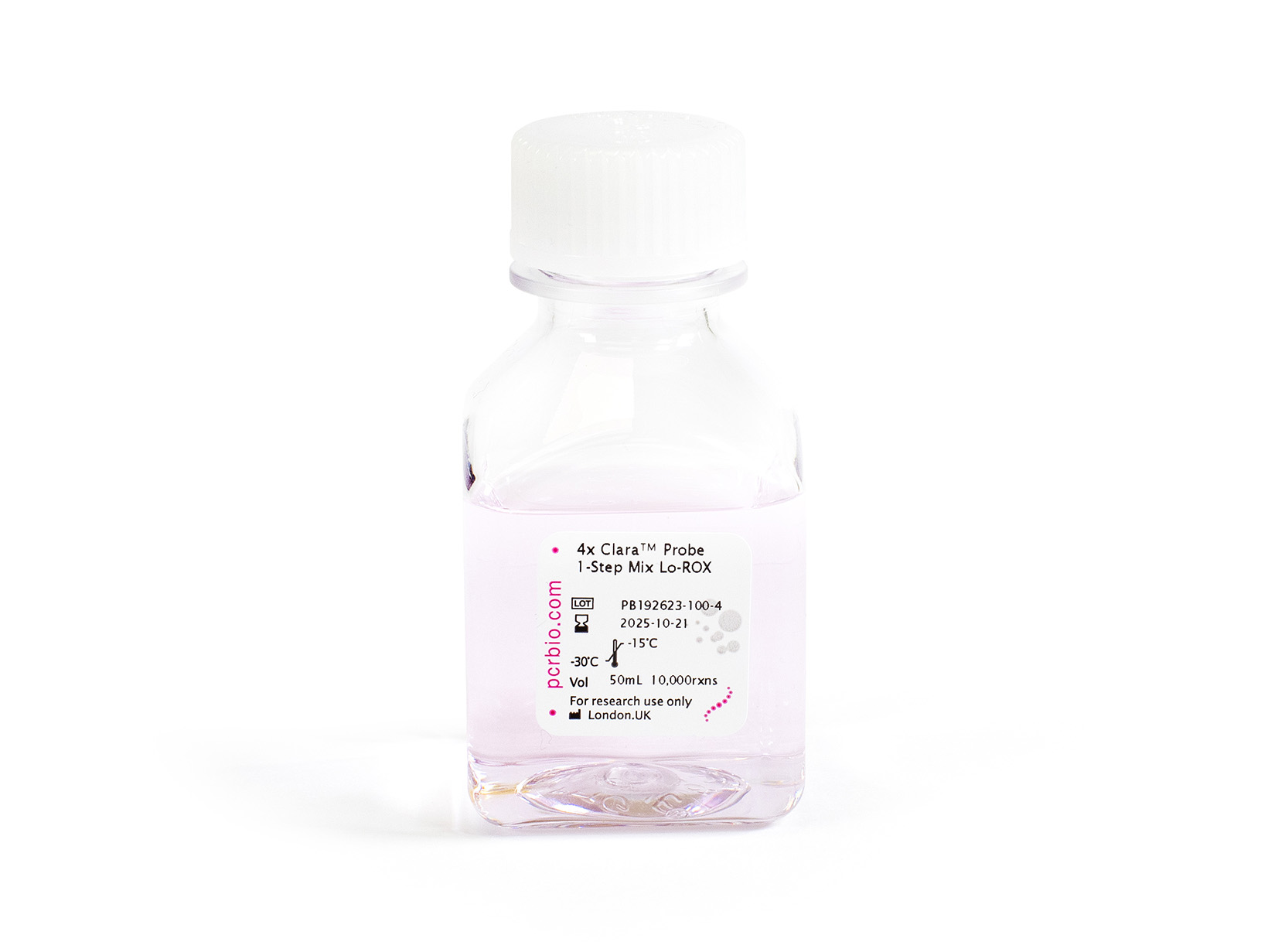
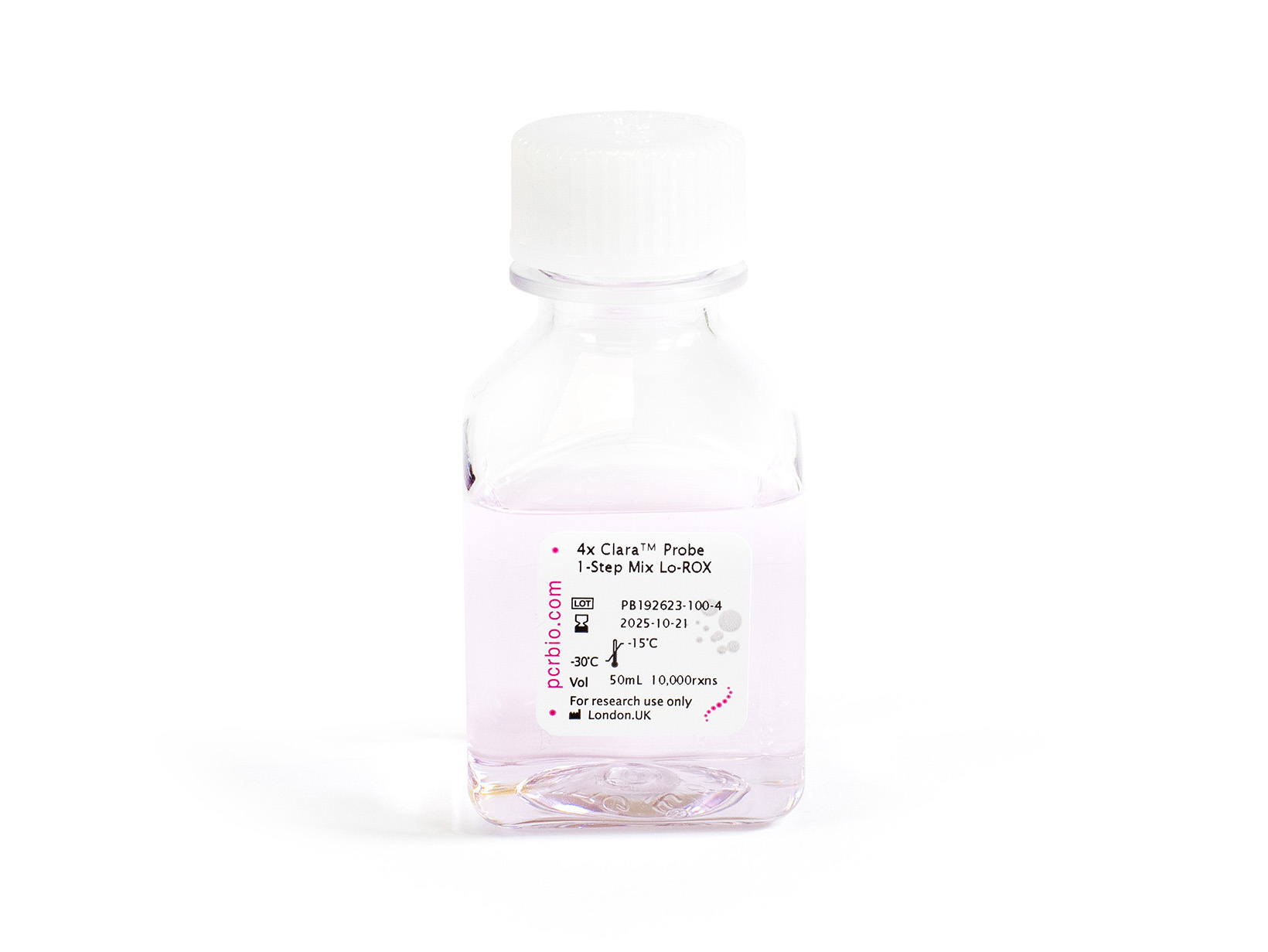
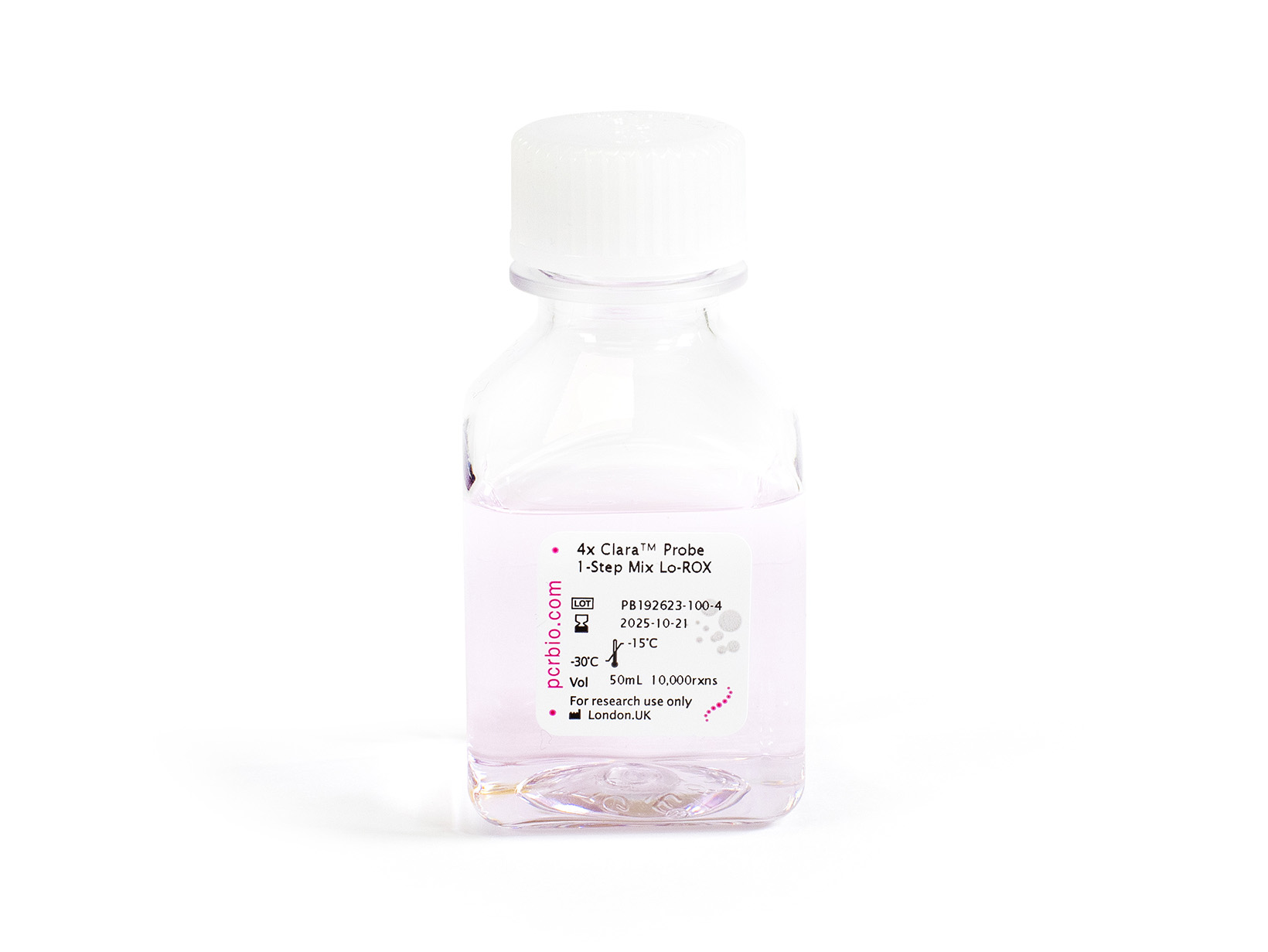
| PB25.81-01 | Clara® Probe 1-Step Mix Lo-ROX | 200 x 20 μL Reactions | Contact Us |
| PB25.81-03 | Clara® Probe 1-Step Mix Lo-ROX | 600 x 20 μL Reactions | Contact Us |
| PB25.81-05 | Clara® Probe 1-Step Mix Lo-ROX | 1000 x 20 μL Reactions (5 x 1 mL) | Contact Us |
| PB25.81-50 | Clara® Probe 1-Step Mix Lo-ROX | 10 000 x 20 μL Reactions (1 x 50 mL) | Contact Us |
| PB25.82-01 | Clara® Probe 1-Step Mix Hi-ROX | 200 x 20 μL Reactions | Contact Us |
| PB25.82-03 | Clara® Probe 1-Step Mix Hi-ROX | 600 x 20 μL Reactions | Contact Us |
| PB25.82-05 | Clara® Probe 1-Step Mix Hi-ROX | 1000 x 20 μL Reactions (5 x 1 mL) | Contact Us |
| PB25.82-50 | Clara® Probe 1-Step Mix Hi-ROX | 10 000 x 20 μL Reactions (1 x 50 mL) | Contact Us |
| PB25.83-01 | Clara® Probe 1-Step Mix No-ROX | 200 x 20 μL Reactions | Contact Us |
| PB25.83-03 | Clara® Probe 1-Step Mix No-ROX | 600 x 20 μL Reactions | Contact Us |
| PB25.83-05 | Clara® Probe 1-Step Mix No-ROX | 1000 x 20 μL Reactions (5 x 1 mL) | Contact Us |
| PB25.83-50 | Clara® Probe 1-Step Mix No-ROX | 10 000 x 20 μL Reactions (1 x 50 mL) | Contact Us |
| PB25.84-01 | Clara® Probe 1-Step Mix Separate-ROX | 200 x 20 μL Reactions | Contact Us |
| PB25.84-03 | Clara® Probe 1-Step Mix Separate-ROX | 600 x 20 μL Reactions | Contact Us |
| PB25.84-05 | Clara® Probe 1-Step Mix Separate-ROX | 1000 x 20 μL Reactions (5 x 1 mL) | Contact Us |
| PB25.89-01 | Clara® Probe 1-Step Mix AquaPlex | 200 x 20 μL Reactions | Contact Us |
| PB25.89-03 | Clara® Probe 1-Step Mix AquaPlex | 600 x 20 μL Reactions | Contact Us |
| PB25.89-05 | Clara® Probe 1-Step Mix AquaPlex | 1000 x 20 μL Reactions (5 x 1 mL) | Contact Us |
| PB25.89-50 | Clara® Probe 1-Step Mix AquaPlex | 10 000 x 20 μL Reactions (1 x 50 mL) | Contact Us |
To see your price, please log in or register with your quotation document.
Technical Specifications
Clara® Probe 1-Step Mix Lo-ROX
| Component | 200 Reactions | 600 Reactions | 1000 Reactions | 10 000 Reactions |
|---|---|---|---|---|
| 4x Clara Probe 1-Step Mix Lo-ROX | 1 x 1 mL | 3 x 1 mL | 5 x 1 mL | 1 x 50 mL |
Clara® Probe 1-Step Mix Hi-ROX
| Component | 200 Reactions | 600 Reactions | 1000 Reactions | 10 000 Reactions |
|---|---|---|---|---|
| 4x Clara Probe 1-Step Mix Hi-ROX | 1 x 1 mL | 3 x 1 mL | 5 x 1 mL | 1 x 50 mL |
Clara® Probe 1-Step Mix No-ROX
| Component | 200 Reactions | 600 Reactions | 1000 Reactions | 10 000 Reactions |
|---|---|---|---|---|
| 4x Clara Probe 1-Step Mix No-ROX | 1 x 1 mL | 3 x 1 mL | 5 x 1 mL | 1 x 50 mL |
Clara® Probe 1-Step Mix Separate-ROX
| Component | 200 Reactions | 600 Reactions | 1000 Reactions |
|---|---|---|---|
| 4x Clara Probe 1-Step Mix No-ROX | 1 x 1 mL | 3 x 1 mL | 5 x 1 mL |
| 50 μM ROX Additive | 1 x 200 μL | 1 x 200 μL | 1 x 200 μL |
Clara® Probe 1-Step Mix AquaPlex
| Component | 200 Reactions | 600 Reactions | 1000 Reactions | 10 000 Reactions |
|---|---|---|---|---|
| 4x Clara Probe 1-Step Mix AquaPlex | 1 x 1 mL | 3 x 1 mL | 5 x 1 mL | 1 x 50 mL |
Reaction Information
| Reaction Volume | Storage | |||
|---|---|---|---|---|
| 20 μL |
Upon receipt, store between -30 °C and -20 °C. If stored correctly, the kit will maintain full activity until the specified expiration date. |
Device Compatibility
This product is compatible with all standard and fast qPCR equipment. Use our qPCR selection tool to find out what ROX type fits your equipment.
Frequently Asked Questions (FAQs)
What Ct value indicates unreliable results?
Ct values can vary depending on sample concentration, reaction optimization, equipment, and laboratories, so care should be taken when selecting a cutoff Ct value. Generally, Ct values above 35-40 are considered unreliable. However, late Cts can be observed for inefficient reactions using low sample copy numbers. It's always good practice to normalize cutoff values with relative or absolute quantification methods. Running and analyzing melt curves or gels of the product to identify products from any late amplification is also recommended.
Can the Clara® Probe 1-Step Mix and Purple Mix be used for both 1-step and 2-step RT-PCR?
Yes. Clara® Probe 1-Step Mix is capable of evenly amplifying cDNA and RNA targets. However, as this mix contains RTase, it is ideal for 1-step procedures. We recommend using Clara® Probe 1-Step Mix for 1-step procedures and when experiments require DNA detection in some limited samples and using Clara® Probe Mix for 2-step protocols and recurring DNA detection.
Can products created with Clara® Purple be digested, cloned, and sequenced?
Yes, the PCR products generated with these mixes are characterized like those produced with wild-type Taq polymerase. They can be sequenced or digested with restriction enzymes using standard protocols. Products have 3′-d(A) overhangs and are suitable for TA cloning or can be cut or digested with restriction enzymes before cloning. For optimal results, we recommend purifying the PCR products with any standard PCR purification kit.
Can ROX negatively affect the reaction?
ROX (6-carboxy-X-rhodamine) is used as a passive reference dye in ROX-dependent real-time PCR instruments to normalize for fluorescence level variations that may occur primarily due to optical changes between wells. The normalization of fluorescence intensity (Rn) is achieved in real-time PCR software by dividing the fluorescent emission intensity of the specific signal by that of ROX.
ROX does not participate in the PCR reaction, and its fluorescence intensity does not correlate with the amount of DNA per well; thus, adding this fluorophore to the mix provides a consistent fluorescence signal throughout the amplification process.
Different real-time PCR instrument types require different optimal ROX concentration passive reference standards, primarily due to varying optical configurations of each system (i.e., different excitation source and optics used).
Adding too little or too much ROX will result in noisy signals that affect the reaction results. Therefore, it is crucial for users to:
- Identify the correct ROX concentration to optimize real-time PCR results, and
- Check ROX settings in the software used to set up the reaction
A useful selection tool for frequently used systems can be found here.
Do Clara® Probe Mix and Clara® Probe 1-Step Mix contain FAM dye?
No. Besides ROX (if present in the kit), there are no other dyes in our mixes. Thus, you can use any fluorophore-labeled probes for your reaction.
Do I need to use an RNase inhibitor in my reactions?
No, this mix contains an RNase inhibitor to prevent any degradation and enhance sensitivity.
Is it normal for the fluorescence of Clara® Probe Mix and Clara® Probe 1-Step Mix to differ from that of competitor products?
Different products can generate different fluorescence levels. However, this does not affect the accuracy of quantification, and Ct values will not differ between products.
Is storing sample DNA in 1x TE buffer (10 mM Tris-HCl / 1 mM EDTA) compatible with downstream qPCR using Clara® Probe Mix and Clara® Probe 1-Step Mix?
Yes, this storage buffer is compatible. EDTA will chelate some magnesium in the mix, but not enough to affect the reaction.
What are the ROX concentrations in Clara® Probe Mix, Clara® Probe 1-Step Mix, and their respective purple mixes?
The Clara® Probe Purple and Clara® Probe 1-Step Purple mixes contain passive reference dyes paired with various formulations, each with different passive reference dye concentrations:
Lo-ROX (PB20.65 and PB25.85) mixes contain 200 nM ROX.
Hi-ROX (PB20.66 and PB25.86) mixes contain 2 µM ROX.
No-ROX (PB20.67 and PB25.87) mixes do not contain ROX.
Separate-ROX (PB20.68 and PB25.88) mixes include a separate tube of 50 µM ROX additive. This allows you to choose the ROX concentration you wish to use.
You can use our qPCR Selection Tool under the Resources dropdown menu to identify which of our mixes best suits your qPCR machine.
What is ROX, and do I need it?
ROX is a passive reference dye meaning it does not participate in the PCR reaction. It is used to normalize for non-PCR related fluorescence fluctuations. You can use our qPCR Selection Tool under the Resources section to determine which qPCR mix best suits your qPCR machine.
What should I do if my reaction is inhibited?
If inhibition is observed, the amount of sample in the reaction can be reduced. This will increase the Ct value but decrease the likelihood that inhibitors interfere with Taq DNA polymerase activity. If this is ineffective, try adding 0.4-4 mg/ml BSA to the reaction1,2. Ensure the cycle conditions in our product guide are followed.
- Kreader, C. A. Relief of amplification inhibition in PCR with bovine serum albumin or T4 gene 32 protein. Appl Environ Microbiol 62, 1102-1106 (1996).
- Wilson, I. G. Inhibition and facilitation of nucleic acid amplification. Appl Environ Microbiol 63, 3741-3751 (1997).
What should I do when amplification efficiency decreases with serial dilutions?
There are reports that efficiency can decrease with subsequent dilutions for the standard curve. We advise avoiding this by diluting standards in 10 mM Tris-HCl pH 8.0, 0.1 mM EDTA, 0.05% Tween-20. EDTA is a chelating agent and plays a role in preventing DNAse activity1. Tween-20 is a detergent and prevents DNA from sticking to the walls of tubes2. Most microcentrifuge tubes are made from polypropylene, and research has shown DNA sticks very well to polypropylene3.
Standards should not be frozen after dilution. Even in the presence of detergent, freezing appears to cause DNA to stick irreversibly to polypropylene. We suggest keeping your standards at 4°C and preparing a fresh batch after several weeks.
- Barra, G. B. et al. EDTA-mediated inhibition of DNases protects circulating cell-free DNA from ex vivo degradation in blood samples. Clin Biochem 48, 976-981, doi:10.1016/j.clinbiochem.2015.02.014 (2015).
- Linnarsson, S. Recent advances in DNA sequencing methods – general principles of sample preparation. Exp Cell Res 316, 1339-1343, doi:10.1016/j.yexcr.2010.02.036 (2010).
- Gaillard, C. & Strauss, F. Avoiding adsorption of DNA to polypropylene tubes and denaturation of short DNA fragments. Technical Tips Online 3, 3 (1998).
What remedial measures are recommended if I have non-specific products in my qPCR?
There are several options to consider when optimizing the reaction:
- Decrease the annealing/extension time to 5 seconds
- Increase the annealing/extension temperature from 60 to 65°C
Dilute the DNA template by starting with 5ng DNA and using a 10x template dilution series. In addition to running these on a gel to see if non-specific products persist, the reaction's performance can be calculated with your qPCR machine's software after performing template dilution. If the performance falls within the range of 90 – 110%, the amplicon is doubling every cycle.
What remedial measures are recommended when Ct values are higher than expected?
Higher Ct values typically indicate delayed amplification. This is likely due to too much template in the reaction causing primers and probes to bind to different DNA molecules. Templates usually contain a lot of non-target DNA and this can distract the oligos. We recommend diluting the templates (10x-1000x) to address this.
Furthermore, the annealing/extension temperature can also be increased to make oligo binding more specific to the target sequence and minimize background signal.
When performing a multiplex, what is the recommended concentration of each primer?
We recommend using 0.4 µM for each primer. There is some flexibility around this recommended concentration, however, the primer concentration should not be increased, as this can significantly affect the enzyme's activity.
For more information on multiplexing, please refer to our qPCR Technical Guide.
Why are there non-specific products using the same primers and PCR conditions as a competitor's product?
This is likely occurring because the time for the first step (hot start) is too short. Ensure that the hot start phase occurs at 95°C for 2 minutes to fully activate the enzyme. The recommended thermal profile is:
- 95°C (120 seconds)
- 40 cycles: 95°C (5-15 seconds) – 60°C (20-30 seconds)
- Melt curve
If non-specific products are still obtained, we recommend increasing the annealing/extension temperature from 60°C to 65°C, depending on the primer set used.
Does this mix work with micro RNA samples?
Yes, the Clara® Probe 1-Step Mix can be used for micro RNA samples. Although we do not sell dedicated kits, all our RTases can be used for miRNA quantification and analysis.
We recommend using one of the following methods:
- Using universal RT primers and adding a poly(A) or poly(U) tail (e.g., with poly(U) polymerase enzyme), followed by cDNA synthesis with universal primers1,2.
- Using specific RT primers and skipping the tailing step 1, 3-5.
If you are unfamiliar with these methods, please refer to the list of publications below, which are considered guide references.
- Dave, V. P. et al. MicroRNA amplification and detection technologies: opportunities and challenges for point of care diagnostics. Lab Invest 99, 452-469, doi:10.1038/s41374-018-0143-3 (2019).
- Mei, Q. et al. A facile and specific assay for quantifying microRNA by an optimized RT-qPCR approach. PLoS One 7, e46890, doi:10.1371/journal.pone.0046890 (2012).
- Chen, C. et al. Real-time quantification of microRNAs by stem-loop RT-PCR. Nucleic Acids Res 33, e179, doi:10.1093/nar/gni178 (2005).
- Raymond, C. K., Roberts, B. S., Garrett-Engele, P., Lim, L. P. & Johnson, J. M. Simple, quantitative primer-extension PCR assay for direct monitoring of microRNAs and short-interfering RNAs. RNA 11, 1737-1744, doi:10.1261/rna.2148705 (2005).
- Androvic, P., Valihrach, L., Elling, J., Sjoback, R. & Kubista, M. Two-tailed RT-qPCR: a novel method for highly accurate miRNA quantification. Nucleic Acids Res 45, e144, doi:10.1093/nar/gkx588 (2017).
Read more