

| CAT No | Product | Size | Price |
|---|---|---|---|
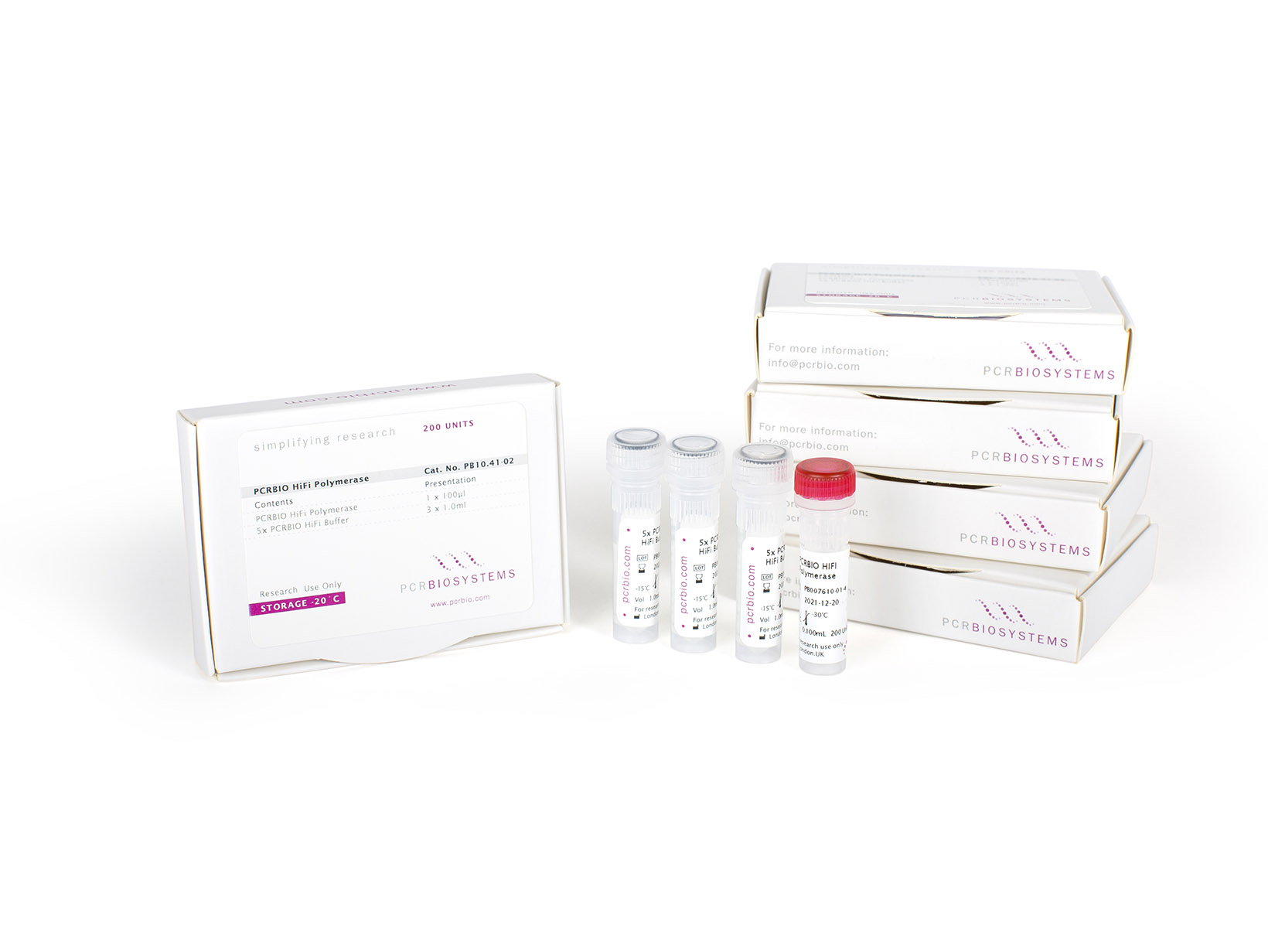
| PB10.41-02 | PCRBIO HiFi Polymerase | 200 Units | Contact us |
| PB10.41-10 | PCRBIO HiFi Polymerase | 1000 Units | Contact us |
To view your pricing, please log in or register with your quote reference.
Specifications
PCRBIO HiFi Polymerase
| Component | 200 Units | 1000 Units | ||
|---|---|---|---|---|
| PCRBIO HiFi Polymerase (2u/μl) | 1 x 100μL | 5 x 100μL | ||
| 5x PCRBIO HiFi Buffer | 3 x 1mL | 15 x 1mL |
Reaction Information
| Reaction Volume | Storage | |||
|---|---|---|---|---|
| Not applicable | Upon receipt, the product should be stored at -30 to -20 °C. If stored correctly, the kit will retain full activity until the expiration date stated. |
Frequently Asked Questions (FAQs)
Can I use PCRBIO HiFi Polymerase if my assays require a specialized buffer?
The PCRBIO HiFi 5x buffer supplied with the PCRBIO HiFi Polymerase has been specially developed for use with this enzyme and we highly recommend using them together. However, PCRBIO HiFi Polymerase should be compatible with any PCR buffer developed for use with Pfu polymerase. If using a custom buffer with PCRBIO HiFi Polymerase, note that reaction parameters such as annealing temperature and enzyme, template, dNTPs, and MgCl2 concentrations may need to be optimized.
Can PCRBIO HiFi Polymerase be used for colony PCR?
Yes. If working from bacterial colonies, use a sterile tip to pick a colony and resuspend in the 50µl PCR reaction. If working from liquid culture, add 5µl of overnight culture to the final mix. Follow the general protocol and increase the initial denaturation time to 10 minutes at 95°C.
Can PCRBIO HiFi Polymerase be used for multiplex PCR?
PCRBIO HiFi Polymerase does not contain hot-start technology, however, it has very low intrinsic activity at lower temperatures, much lower than Taq Polymerase without the hot start. This means that it may be used for some multiplex applications.
When performing multiplex PCR for the first time, we recommend performing a temperature gradient annealing from 55°C to 65°C. The annealing temperature that provides the best specificity should be used in subsequent experiments. Fast cycling conditions should not be used for multiplex PCR. We recommend an extension time of 90 seconds to start, which can be increased to improve yield.
For multiplex reactions, reactions should be set up on ice or a cold block from start to finish. Primers should be carefully designed to minimize overlapping sequences as much as possible while maintaining diverse amplicon lengths that can be easily analyzed with your endpoint detection method1-3. Please note the amplicon length limits for PCRBIO HiFi Polymerase. If one of your amplicons is near the limit, consider using VeriFi® Polymerase.
1 Markoulatos, P., Siafakas, N. & Moncany, M. Multiplex polymerase chain reaction: a practical approach. J Clin Lab Anal 16, 47-51, doi:10.1002/jcla.2058 (2002).
2 Radhika, M., Saugata, M., Murali, H. S. & Batra, H. V. A novel multiplex PCR for the simultaneous detection of Salmonella enterica and Shigella species. Brazilian Journal of Microbiology 45, 667-676, doi:10.1590/s1517-83822014005000041 (2014).
3 Perez-Perez, F. J. & Hanson, N. D. Detection of plasmid-mediated AmpC beta-lactamase genes in clinical isolates by using multiplex PCR. J Clin Microbiol 40, 2153-2162, doi:10.1128/jcm.40.6.2153-2162.2002 (2002).
Does PCRBIO HiFi Polymerase have proofreading ability?
Yes. PCRBIO HiFi Polymerase has 3’-5’ exonuclease (proofreading) activity.
My results have high background of non-specific amplicons or smears. Do you have any troubleshooting tips?
If smearing is a concern, it is often good to ensure that they are not products of running agarose gel electrophoresis under suboptimal conditions. Suboptimal conditions can include high voltages or not allowing sufficient time for the gel to set1.
You may also need to troubleshoot the PCR reaction and consider the suggestions and publications below2.
- Primers should be designed to prevent primer-dimer interactions and improve specificity.
- Increase annealing temperature or perform a PCR annealing temperature gradient to determine the optimal annealing temperature.
- Reduce template amount in the reaction. For high-quality DNA use 1–100 ng of genomic DNA or ≤5 ng plasmid/Lambda DNA per 50 µL reaction.
- Reduce the number of cycles.
- Reduce the enzyme amount per reaction.
- Reduce the primer concentration, but not lower than 100 nM for each primer.
- Include DMSO in the reaction to a final concentration of 5%–10%.
1 Koontz, L. Agarose Gel Electrophoresis. Laboratory methods in enzymology : DNA. First edition. edn, Vol. 529 35-45 (2013).
2 Lorenz, T. C. Polymerase chain reaction: basic protocol plus troubleshooting and optimization strategies. J Vis Exp, e3998, doi:10.3791/3998 (2012).
My results show very low yield. Do you have any troubleshooting tips?
You may want to consider the suggestions below and refer to the publication1.
- Optimize annealing temperature in a PCR annealing temperature gradient.
- Increase the amount of template in the reaction.
- Increase the number of cycles.
- Increase the enzyme amount per reaction.
- Increase primer concentration, but not exceeding 1 µM for each primer.
- Try a new dNTP solution.
- Optimize MgCl2
1 Lorenz, T. C. Polymerase chain reaction: basic protocol plus troubleshooting and optimization strategies. J Vis Exp, e3998, doi:10.3791/3998 (2012).
What is the difference between PCRBIO HiFi Polymerase and VeriFi® Polymerase?
VeriFi® Polymerase has superior processivity compared to PCRBIO HiFi Polymerase, resulting in shorter extension times (10-30 s/kb), higher yields, and the ability to amplify longer (up to 17.5 kb) and more difficult targets. VeriFi® Polymerase also has higher reliability than PCRBIO HiFi Polymerase. Unlike PCRBIO HiFi polymerase, VeriFi® Polymerase is available as a convenient 2x mix with the option of a red dye for direct gel loading, saving time during reaction setup and analysis.
What is the error rate of PCRBIO HiFi Polymerase?
PCRBIO HiFi Polymerase has an error rate of approximately 1 error per 4.5 x 10⁷ bases incorporated. This is more than 50 times lower than PCRBIO Taq DNA polymerase.
What is the recommended extension time for PCRBIO HiFi Polymerase?
30 seconds per kilobase (kb) is recommended for amplification from eukaryotic DNA. The extension time can be shortened for viral and bacterial DNA.
What cloning strategy should I use with a fragment generated by PCRBIO HiFi polymerase?
PCR products generated by PCRBIO HiFi polymerase have blunt ends, making them suitable for blunt-end cloning without any further modifications.
If you wish to add A-overhangs, you can use Taq DNA Polymerase or Klenow (exo-) DNA followed by TA cloning1. Before proceeding with A-overhang addition, ensure that PCRBIO HiFi polymerase has been removed from the reaction. If any PCRBIO HiFi Polymerase remains, the enzyme’s 3’-5’ exonuclease activity may remove the A-overhangs.
1 Yao, S., Hart, D. J. & An, Y. Recent advances in universal TA cloning methods for use in function studies. Protein Eng Des Sel, doi:10.1093/protein/gzw047 (2016).
See more