

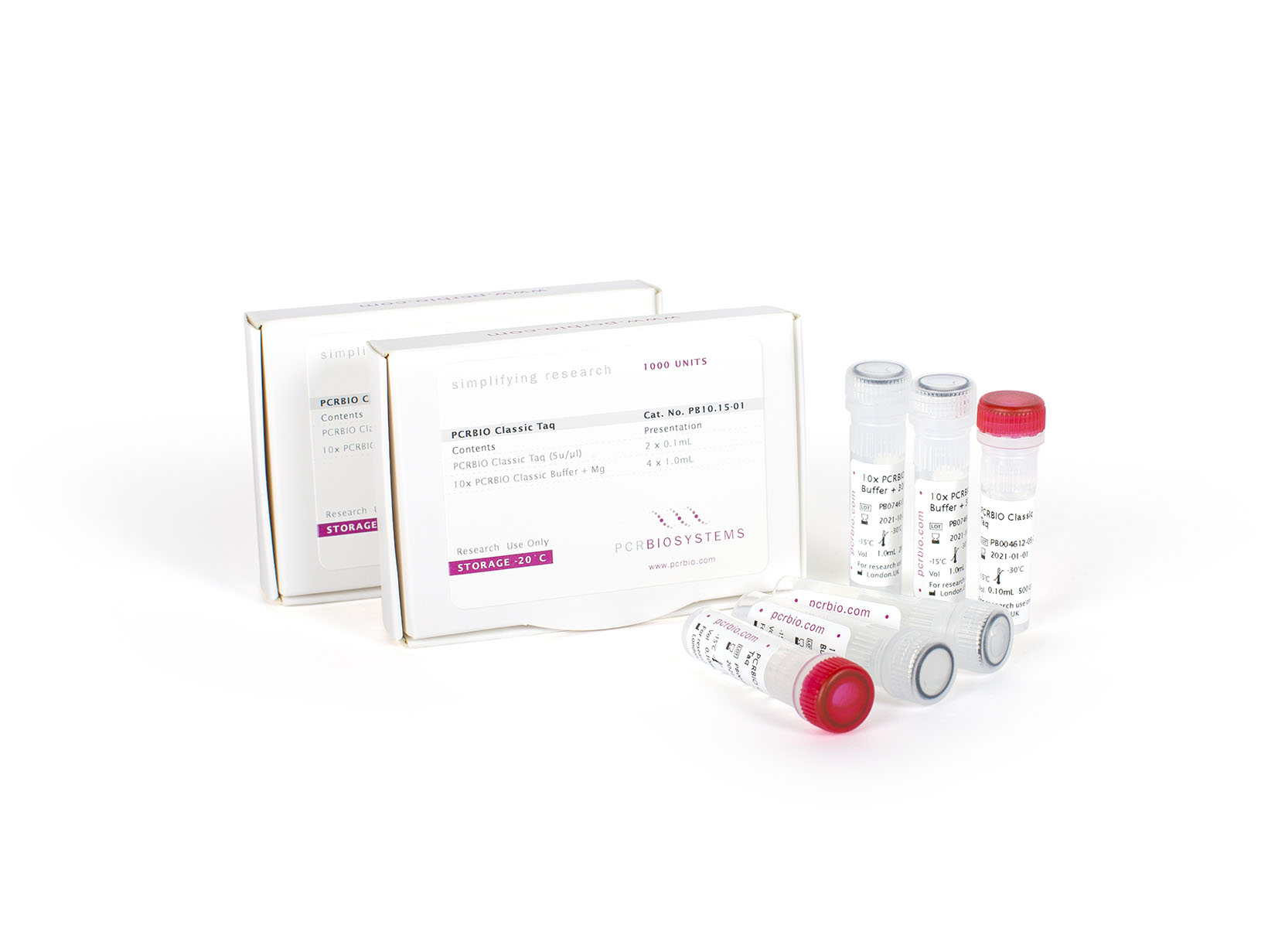
| CAT Number | Product | Size | Price |
|---|---|---|---|
| PB10.15-01 | PCRBIO Classic Taq | 1000 Units | Contact us |
| PB10.15-02 | PCRBIO Classic Taq | 2000 Units | Contact us |
| PB10.15-06 | PCRBIO Classic Taq | 6000 Units | Contact us |
To view your pricing, please log in or register with your quote reference.
Technical Specifications
PCRBIO Classic Taq
| Component | 1000 Units | 2000 Units | 6000 Units | |
|---|---|---|---|---|
| PCRBIO Classic Taq (5u/μL) | 2 x 100μL | 4 x 100μL | 12 x 100μL | |
| 10x PCRBIO Classic Buffer + 30mM MgCl2 | 4 x 1mL | 8 x 1mL | 24 x 1mL |
Reaction Information
| Reaction Volume | Storage | |||
|---|---|---|---|---|
| 50μL | Upon receipt, the kit should be stored at temperatures between -30 to -20 °C. If stored correctly, the kit will maintain full activity until the designated expiration date. |
Frequently Asked Questions (FAQs)
Can I use PCRBIO Classic Taq if my assay calls for a special buffer?
The PCRBIO 10x reaction buffer supplied with PCRBIO Classic Taq has been specifically formulated for this enzyme and we highly recommend using them together. However, PCRBIO Classic Taq should be compatible with any PCR buffer designed for use with a wild-type Taq. If you use a custom buffer with PCRBIO Classic Taq, please bear in mind that reaction parameters such as annealing temperature and concentrations of enzyme, template, dNTPs, and MgCl2 may need optimization.
Can PCRBIO Classic Taq be used for colony PCR?
Yes. If working from bacterial colonies, use a sterile pipette tip to pick a colony into a 50µl PCR reaction. If working from a liquid culture, add 5µl of overnight culture to the final mix. Follow the standard procedure and increase the initial denaturation step to 10 minutes at 95°C.
Can PCRBIO Classic Taq be used to amplify DNA from blood samples?
Yes. Use 2 µL blood sample per 50 µL PCR reaction and follow the standard procedure. Be aware that components of blood may inhibit the PCR reaction. Perform a serial dilution of the sample to find the optimal sample concentration for efficient PCR amplification.
Does PCRBIO Classic Taq have proofreading ability?
No. PCRBIO Classic Taq has a 5’-3’ exonuclease activity, but it does not have a 3’-5’ exonuclease (proofreading) activity.
Does PCRBIO Classic Taq produce A-tailed or blunt products?
PCR products generated by PCRBIO Classic Taq are A-tailed, making them suitable for TA cloning. For more information, please refer to the document1.
1 Yao, S., Hart, D. J. & An, Y. Recent advances in universal TA cloning methods for use in function research. Protein Eng Des Sel, doi:10.1093/protein/gzw047 (2016).
My results have a high amount of nonspecific amplicon or smears. Do you have any troubleshooting tips?
If smearing is a concern, good practice is to ensure that it is not an artifact caused by running an agarose gel with suboptimal conditions. Suboptimal conditions may include high voltage or not letting the gel solidify sufficiently1.
You may also want to reevaluate the PCR reaction and consider the following suggestions2.
- Primers should be designed to prevent primer-dimer formation and improve specificity.
- Increase the annealing temperature or perform a gradient PCR to determine the optimal annealing temperature.
- Reduce the amount of template in the reaction. For high-quality DNA, use 1–100 ng genomic DNA or ≤5 ng plasmid/lambda DNA per 50 µL reaction.
- Reduce the number of cycles.
- Reduce the amount of enzyme per reaction.
- Reduce the primer concentration, but not below 100 nM of each primer.
- Add DMSO to the reaction at a final concentration of 5%–10%.
1 Koontz, L. Agarose gel electrophoresis. Methods in enzymology: DNA. First Edition, Volume 529 35-45 (2013).
2 Lorenz, T. C. Polymerase chain reaction: basic protocol plus troubleshooting and optimization strategies. J Vis Exp, e3998, doi:10.3791/3998 (2012).
My results show very low yield. Do you have any troubleshooting tips?
You may want to consider the following suggestions and also refer to the document1.
- Optimize the annealing temperature in a gradient PCR.
- Increase the amount of template in the reaction.
- Increase the number of cycles.
- Increase the amount of enzyme per reaction.
- Increase the primer concentration, but do not exceed 1 µM of each primer.
- Try a new dNTP solution.
- Optimize MgCl2
1 Lorenz, T. C. Polymerase chain reaction: basic protocol plus troubleshooting and optimization strategies. J Vis Exp, e3998, doi:10.3791/3998 (2012).
What are the storage recommendations for PCRBIO Classic Taq?
Upon receipt, the kit should be stored at -20°C. Avoid prolonged exposure to light. If stored properly, the kit will maintain full activity for 12 months. The kit can be stored at 4°C for 1 month.
What is the difference between PCRBIO Classic Taq and PCRBIO Taq DNA Polymerase?
The PCRBIO Classic Taq enzyme is supplied with 10x PCRBIO Classic Buffers, with the buffer containing 30 mM MgCl2. dNTPs are sold separately and must be added to the final reaction. The PCRBIO Taq DNA Polymerase is supplied with 5x PCRBIO Reaction Buffer, with the buffer containing both MgCl2 and dNTPs. Additionally, PCRBIO Taq DNA Polymerase is also available as a 2x Mix for added convenience, with and without a red dye for direct loading onto agarose gels.
What is the error rate of PCRBIO Classic Taq?
The enzyme has an error rate of approximately 1 error per 2.0 x 10⁵ nucleotides incorporated.
What is the recommended extension time for PCRBIO Classic Taq?
15 seconds per kilobase (kb) for amplification from eukaryotic DNA with amplicons between 1kb and 6kb. For shorter amplicons, a 1-second extension is sufficient.
Read more