

| CAT Code | Product | Size | Price |
|---|---|---|---|
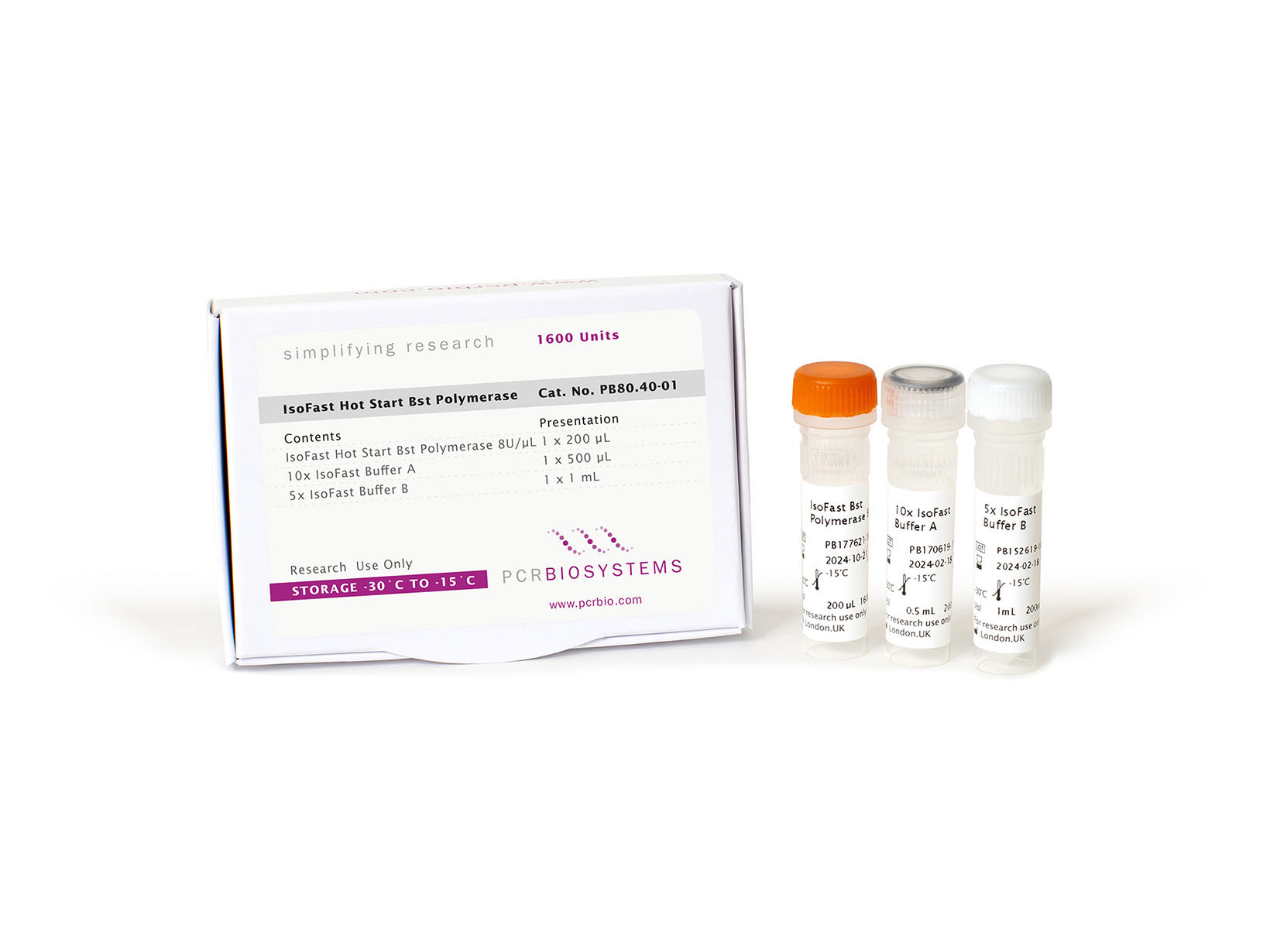
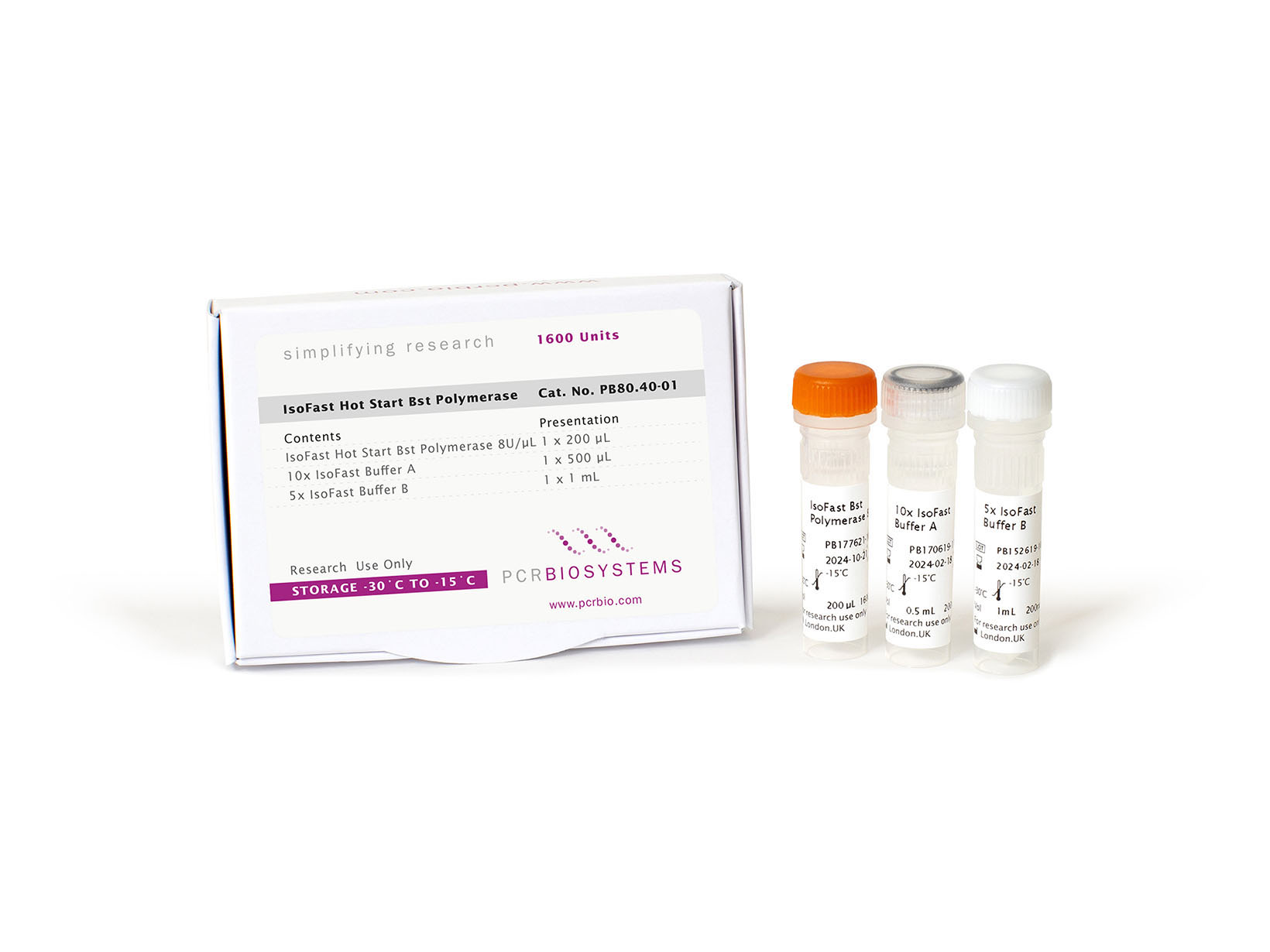
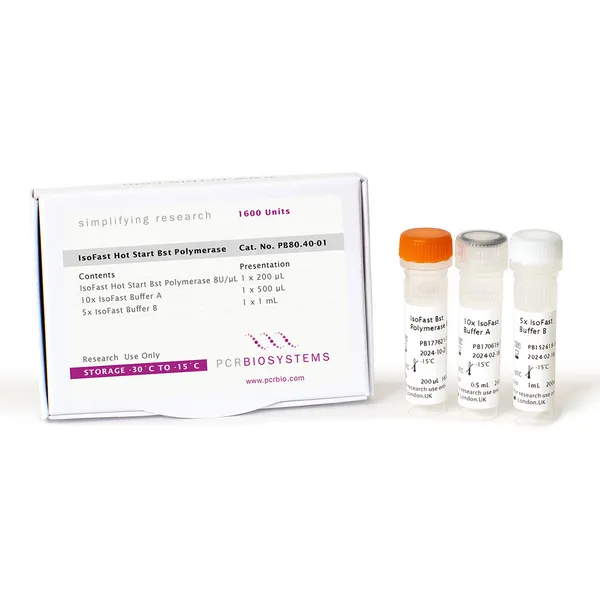
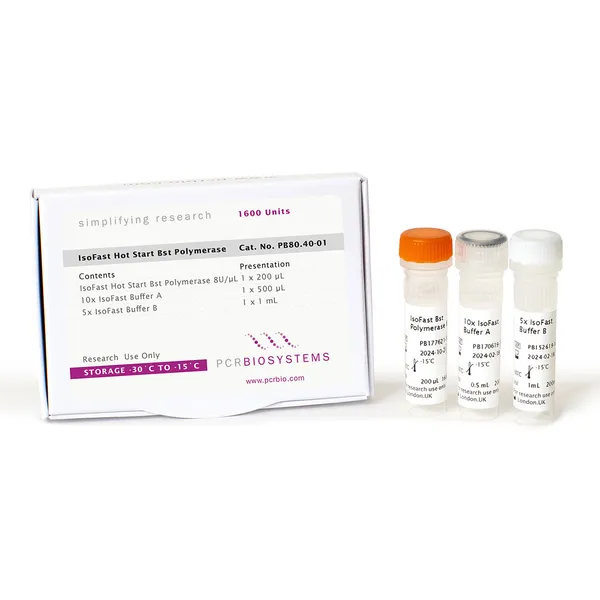
| PB80.40-01 | IsoFast® Hot Start Bst Polymerase | 1600 Units | Contact us |
| PB80.40-08 | IsoFast® Hot Start Bst Polymerase | 8000 Units | Contact us |
| PB80.41-01 | IsoFast® Hot Start Bst Polymerase with Dye | 1600 Units | Contact us |
| PB80.41-08 | IsoFast® Hot Start Bst Polymerase with Dye | 8000 Units | Contact us |
| PB80.42-01 | IsoFast® Hot Start Bst Mix | 100 x 25 μL Reactions | Contact us |
| PB80.42-05 | IsoFast® Hot Start Bst Mix | 500 x 25 μL Reactions | Contact us |
To view your price, please login or register with your quote code.
Specifications
IsoFast® Hot Start Bst Polymerase
| Component | 1600 Units | 8000 Units | ||
|---|---|---|---|---|
| IsoFast Hot Start Bst Polymerase 8 U/μL | 1 x 200 μL | 1 x 1 mL | ||
| 10x IsoFast Buffer A | 1 x 500 μL | 2 x 1.25 mL | ||
| 5x IsoFast Buffer B | 1 x 1 mL | 3 x 1.7 mL |
IsoFast® Hot Start Bst Polymerase with Dye
| Component | 1600 Units | 8000 Units | ||
|---|---|---|---|---|
| IsoFast Hot Start Bst Polymerase 8 U/μL | 1 x 200 μL | 1 x 1 mL | ||
| 10x IsoFast Buffer A | 1 x 500 μL | 2 x 1.25 mL | ||
| 5x IsoFast Buffer B | 1 x 1 mL | 3 x 1.7 mL | ||
| 20x Fluorescent Dye | 2 x 125 μL | 2 x 625 μL |
IsoFast® Hot Start Bst Mix
| Component | 100 Reactions | 500 Reactions | ||
|---|---|---|---|---|
| 2x IsoFast Hot Start Bst Mix | 1 x 1.25 mL | 5 x 1.25 mL | ||
| 20x Fluorescent Dye | 1 x 125 μL | 1 x 625 μL |
Reaction Information
| Reaction Volume | Storage | |||
|---|---|---|---|---|
| 25 μL | Upon arrival, it is recommended to store the product at -30 to -20 °C. If stored properly, the kit will retain activity until the specified expiration date. |
Frequently Asked Questions (FAQs)
Can I use IsoFast® Hot Start Bst amplified products in downstream applications such as cloning or sequencing?
Certain isothermal amplification strategies can be used for downstream applications, for example, RCA (rolling circle amplification) or WGA (whole genome amplification) for NGS. IsoFast® Hot Start Bst reagents can be used for this type of amplification. However, the most common form of isothermal amplification, LAMP, produces a variety of DNA products, making it unsuitable for cloning and impractical for NGS applications.
What types of nucleic acids can be amplified with IsoFast® Hot Start Bst reagents?
The IsoFast® Hot Start Bst Polymerase enzyme, IsoFast® Hot Start Bst Mix, IsoFast® Hot Start Bst Colour Mix, and IsoFast® Hot Start Bst Polymerase Colour are all designed to amplify DNA and cDNA targets. They are not suitable for direct amplification of RNA targets.
For amplifying RNA targets, we recommend using our IsoFast® Bst 1-Step Mix for one-step isothermal amplification. Alternatively, we suggest a two-step format where RNA is first converted to cDNA using one of our UltraScript® reagents, followed by cDNA amplification using the user's preferred IsoFast® Hot Start Bst reagents.
Read more